
Course Description:
Words matter. This free 1-credit micro course helps educators develop respectful, inclusive, and person-centered language when discussing disabilities and supporting students with diverse learning needs. Participants will explore disability terminology, person-first and identity-first language, common misconceptions, and practical strategies for communicating with students, families, and colleagues in ways that promote dignity, belonging, and inclusion.
Through brief, engaging learning activities, educators will gain greater confidence in discussing disabilities thoughtfully and creating more inclusive school environments for all students.
Course Details:
Cost: Free
Credit: 1 Professional Development Credit
Format: Self-paced micro course
Audience: K–12 educators, support staff, administrators, and anyone interested in inclusive practices.
This counts towards the 10 required SPED credits for the Colorado Department of Education license renewal!

In this course, participants will learn the difference between cultural load and cognitive load. Multilingual learners often face substantial barriers to accessing learning. Teachers will apply this new learning in a way that supports reducing barriers for multilingual learning.
This course counts towards compliance with Colorado’s requirement for license renewal for ELLs (2 credit hours of the 45 hours required).
Join us for summer PD 2026. Sessions will take place June 8, 10, 22 and 24 (7-9pm on Zoom) for 10 Special Ed credits in alignment with the Colorado Department of Education for license renewal.
You may save this receipt and provide as proof of a Colorado educator tax deduction.

One pass. One year. Unlimited Access. Endless Possibilities.
The Bright Path PD All Access Pass gives you everything you need to grow your practice—without the cost, complexity, or limitations of traditional professional development.
For one low, fixed price, you’ll get unlimited access for a full year to our library of high-quality, practical, research-based courses designed for real educators in real classrooms. No subscriptions. No renewals. No piecing together credits one course at a time.
Whether you’re working in a K–12 school, homeschool setting, microschool, or flexible learning environment, you can learn on your schedule, at your pace, and focus on what matters most—supporting your students.
No gimmicks. No auto-renewals. Just access.
Directions for purchase:
Add to cart
Complete Purchase
You will receive a download with next steps including a code that will be emailed to you within 24 hours.

This 45-hour course equips educators with research-based strategies to effectively support English Language Learners (ELLs) in K–12 classrooms. Aligned with Colorado Department of Education (CDE) standards, participants will deepen their understanding of language acquisition, culturally and linguistically responsive instruction, and scaffolded content delivery. The course emphasizes practical application, ensuring educators can immediately implement strategies that improve access, engagement, and academic outcomes for multilingual learners. THIS COURSE MEETS THE REQUIREMENTS FOR LICENSE RENEWAL WITH THE COLORADO DEPARTMENT OF EDUCATION. For. more information see here: CDE EDUCATION PROFESSIONAL DEVELOPMENT REQUIREMENTS.
Learning Objectives
By the end of this course, participants will be able to:
Explain stages of second language acquisition and their instructional implications
Design and deliver scaffolded, standards-aligned lessons for ELLs
Integrate language objectives with content objectives
Apply culturally responsive and trauma-informed instructional practices
Use formative and summative assessments to support language development
Differentiate instruction to meet diverse proficiency levels
Course Modules
Foundations of Language Development
Second language acquisition theory
Sociocultural and linguistic considerations
Language Objectives & Academic Language
Writing measurable language objectives
Supporting academic discourse
Scaffolded Instructional Strategies
Gradual release model
Sentence frames, visuals, and modeling
Culturally & Linguistically Responsive Teaching
Asset-based approaches
Building inclusive learning environments
Assessment for ELLs
Formative assessment strategies
Progress monitoring and data use
Application & Instructional Planning
Lesson design and implementation
Reflection and instructional refinement

This 8-credit course provides educators with a comprehensive, practical understanding of the Sheltered Instruction Observation Protocol (SIOP) Model, a research-based framework designed to support English Learners in accessing grade-level content while developing academic language.
Participants will explore all eight components of the SIOP Model, including lesson preparation, building background, comprehensible input, strategies, interaction, practice and application, lesson delivery, and review and assessment. Through real-world application, reflection, and instructional planning, educators will learn how to design and deliver lessons that intentionally integrate language and content objectives.
This course emphasizes immediate classroom application, equipping educators with strategies to scaffold instruction, increase student engagement, and support multilingual learners across content areas. Participants will develop aligned lesson plans, implement SIOP strategies, and analyze their impact on student learning.
Aligned with Colorado Department of Education expectations for English Learner professional development, this course supports educators in strengthening equitable instructional practices and improving outcomes for diverse learners.
Lesson Objectives:
- Explain the purpose, research base, and structure of the SIOP Model
- Identify and describe the eight components of the SIOP Model
- Design standards-aligned lesson plans with clear content and language objectives
- Integrate SIOP features into lesson planning to support English Learners
- Build and connect to students’ background knowledge to enhance comprehension
- Apply strategies for comprehensible input, including visuals, modeling, and adapted instruction
- Implement scaffolding techniques to support language development across proficiency levels
- Facilitate structured student interaction to promote academic language use
- Design opportunities for meaningful practice and application of content and language skills
- Develop formative and summative assessments aligned to content and language objectives
- Monitor student progress and adjust instruction based on data and observation
- Reflect on instructional practices to improve outcomes for English Learners
- Apply SIOP strategies to create inclusive and equitable learning environments

This course provides educators with a foundational understanding of how language is learned, with a focus on the theories, research, and historical perspectives that have shaped language acquisition and instruction. Participants will explore key concepts in first and second language development, examine major theoretical frameworks, and develop a deeper understanding of the linguistic, cognitive, and social factors that influence how students acquire language.
Rather than focusing on instructional strategies, this course builds the conceptual knowledge educators need to interpret student language development, understand diverse learner needs, and make informed instructional decisions. Grounded in research and theory, this course supports educators in developing a strong foundation for working with multilingual learners across educational settings.
Lesson Objectives:
- Explain the difference between first language acquisition and second language learning
- Describe major theories of language acquisition, including behaviorist, nativist, interactionist, and sociocultural perspectives
- Analyze the contributions of key researchers (e.g., Krashen, Cummins, Vygotsky, Chomsky) to the field of language learning
- Define and distinguish between key concepts such as BICS and CALP, input vs. output, and acquisition vs. learning
- Examine the role of comprehensible input in language development
- Understand the concept of the affective filter and its impact on language acquisition
- Explain stages of second language development and what they indicate about learner progress
- Describe the relationship between language, cognition, and academic development
- Analyze how culture and identity influence language learning
- Understand the role of social interaction and environment in language acquisition
- Explain how multilingualism impacts brain development and learning
- Interpret common misconceptions about language learners and language acquisition
- Examine historical shifts in language learning theory and their impact on education
- Develop a conceptual framework for understanding how students acquire academic language

Teaching is one of the most meaningful professions—but it can also be one of the most stressful. This course provides practical strategies teachers can immediately apply to reduce stress, manage classroom challenges, streamline grading, and create a healthier work-life balance. Participants will explore research on teacher burnout, learn evidence-based stress management techniques, and discover efficient systems for managing student behavior, grading, and workload. The goal is to help educators build sustainable practices that support both teacher well-being and student success.
Course Learning Objectives:
1. Identify common sources of teacher stress and burnout within the profession.
2. Implement proactive classroom management strategies that reduce disruptive behavior.
3. Apply efficient grading practices that reduce workload while maintaining meaningful feedback for students.
4. Utilize stress management techniques that support educator well-being and resilience.
5. Develop a practical action plan to improve classroom systems and reduce professional stress.

This two-hour professional learning course equips educators with the knowledge and tools to recognize, understand, and respond to child traumatic stress in school settings. Aligned with HB20-1128 and HB20-1312 as required by the Colorado Department of Education, this training emphasizes the impact of trauma on brain development, behavior, and learning, and provides practical strategies educators can use to create safe, supportive, and responsive classroom environments.
Participants will explore the types and sources of trauma, including adverse childhood experiences (ACEs), chronic stress, and acute traumatic events. The course highlights how trauma may present in the classroom—often through behavior, disengagement, or academic challenges—and reframes these responses through a trauma-informed lens.
Educators will learn how to respond to students in ways that promote regulation, safety, and trust, while maintaining appropriate boundaries and aligning with school protocols. The course also emphasizes culturally responsive practices and the importance of recognizing how trauma disproportionately impacts historically marginalized communities.
By the end of the course, participants will be equipped with actionable strategies to support students affected by trauma, reduce re-traumatization, and foster resilience and connection in their classrooms.
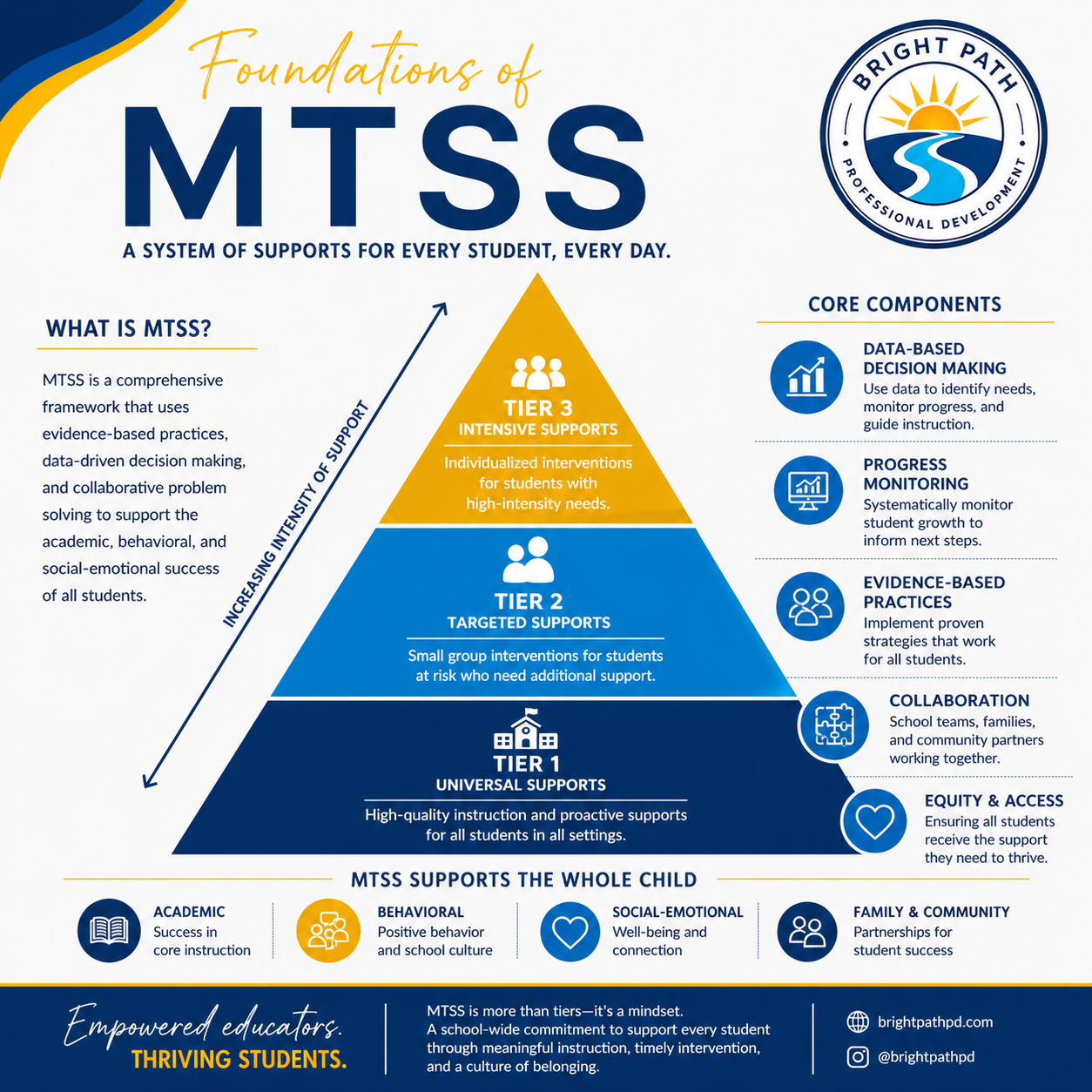
Introduction to Multi-Tiered Systems of Support (MTSS) provides educators with a foundational understanding of how schools organize academic and behavioral supports to meet the needs of all students. Participants will explore the core components of MTSS, including tiered instruction, data-informed decision making, and systems for monitoring student progress.
Educators will examine practical examples of tiered supports and develop strategies to strengthen instruction and intervention within their classrooms and schools. Participants who complete the course will receive a professional development certificate that may be submitted toward educator license renewal requirements.
This course qualifies for CDE compliance with HB 20-1128 and HB 20-1312 requirements for licensure renewal (see below).
As result of HB 20-1128 and HB 20-1312:
Special services providers, principals and administrators are required to complete a minimum of 10 contact hours of professional learning in:
Increasing awareness of laws and practices pertaining to educating students with disabilities in the classroom, including but not limited to Child Find and inclusive learning environments.
Teachers are required to complete a minimum of 10 contact hours of professional learning - with a minimum of one (1) contact hour in each area - in:
Behavioral health that is culturally responsive and trauma- and evidence-informed; and
Increasing awareness of laws and practices pertaining to educating students with disabilities in the classroom, including but not limited to Child Find and inclusive learning environments.

This course provides educators, administrators, and support staff with a comprehensive understanding of Child Find obligations in Colorado under the Individuals with Disabilities Education Act (IDEA). Participants will explore the legal requirements, processes, and practical considerations for identifying, locating, and evaluating students who may have disabilities.
The course emphasizes Colorado-specific guidance while building a strong foundation in federal law, including timelines, referral processes, evaluation procedures, and the responsibilities of school districts and educators. Participants will also examine common misconceptions, equity considerations, and the risks associated with delayed or inadequate identification.
By the end of this course, educators will understand their role in ensuring that all students who may require special education services are appropriately identified and supported.
Learning Objectives
Define Child Find under IDEA and Colorado law
Explain the legal obligations of school districts regarding identification of students with disabilities
Identify who qualifies under Child Find, including students in public, private, homeschool, and highly mobile populations
Describe the referral process for special education evaluation in Colorado
Understand timelines and procedural requirements for evaluation and eligibility determination
Differentiate between MTSS and Child Find responsibilities
Identify early warning signs that may indicate a need for evaluation
Explain the role of general education teachers in the Child Find process
Understand parental rights and procedural safeguards related to Child Find
Analyze common delays and barriers to identification and their impact on students
Recognize equity considerations in Child Find, including disproportionality and under-identification
Explain documentation requirements and best practices for compliance
This course meets the Colorado Department of Education Special Education and Behavioral Health Licensure Renewal Requirements.

This course explores the critical role of leadership in addressing teacher retention by focusing on the experiences and needs of beginning educators. Participants will examine the key factors contributing to early-career teacher attrition, including workload demands, classroom complexity, and gaps in systemic support. Grounded in adult learning theory and early-career development, the course provides a framework for understanding how teachers grow—and where they are most vulnerable. This course qualifies for teacher and principal renewal credits.
Building on this foundation, participants will engage with research-based leadership practices that directly impact new teacher success. Emphasis is placed on creating clarity, delivering meaningful feedback, and fostering psychologically safe environments where beginning educators can develop confidence and instructional skill. Leaders will reflect on how their communication, decision-making, and expectations shape teacher engagement and long-term commitment.
The course also centers on the importance of well-being and organizational culture in sustaining educators. Participants will explore strategies to design supportive systems that promote balance, trust, and inclusion, while addressing the structural conditions that contribute to burnout. By the end of the course, leaders will be equipped with practical approaches to strengthen retention through intentional leadership, supportive culture, and sustainable practices for beginning teachers.

Recognizing and Responding to Teen Suicide Risk: A Colorado Educator Training (HB20-1128 & HB20-1312 Aligned)
Course Description:
This two-hour professional learning course equips Colorado educators with the knowledge and practical tools to recognize, respond to, and support students at risk for suicide. Aligned with HB20-1128 and HB20-1312, the course emphasizes early identification, appropriate intervention, and school-based prevention strategies within a Multi-Tiered System of Supports (MTSS) framework.
Participants will explore warning signs, risk and protective factors, and the impact of trauma, mental health challenges, and environmental stressors on adolescent well-being. The course prioritizes real-world application, guiding educators through what to say, what not to say, and how to take immediate, appropriate action when a student is in distress.
Educators will also learn how to collaborate with school mental health professionals, follow mandated reporting protocols, and support a safe and inclusive classroom environment that reduces stigma and promotes help-seeking behaviors. Special attention is given to culturally responsive practices and supporting students from historically marginalized populations.
By the end of the course, participants will leave with clear protocols, conversation strategies, and classroom-based prevention tools they can implement immediately to support student safety and well-being.
Learning Outcomes:
Participants will be able to:
Identify warning signs and risk factors associated with teen suicide
Respond appropriately to students expressing suicidal ideation
Apply school-based protocols aligned with Colorado law and district policy
Use trauma-informed and culturally responsive communication strategies
Implement Tier 1 prevention practices that promote student connectedness and resilience
*This course is not designed for mental health professionals nor should it be construed as mental health or counseling advice. This course is designed to be educative in nature geared toward educators working with teens in a supportive capacity.

Introduction to Special Education and Special Populations (5 Credit Hours) is a self-paced course that introduces educators to the foundations of special education, inclusive practices, and the needs of diverse learners.
Participants explore key concepts, legal frameworks, and practical strategies for supporting students with disabilities and other special populations. Completion includes a certificate for 5 professional development credit hours.
——
This course qualifies for CDE compliance with HB 20-1128 and HB 20-1312 requirements for licensure renewal (see below).
As result of HB 20-1128 and HB 20-1312:
Special services providers, principals and administrators are required to complete a minimum of 10 contact hours of professional learning in:
Increasing awareness of laws and practices pertaining to educating students with disabilities in the classroom, including but not limited to Child Find and inclusive learning environments.
Teachers are required to complete a minimum of 10 contact hours of professional learning - with a minimum of one (1) contact hour in each area - in:
Behavioral health that is culturally responsive and trauma- and evidence-informed; and
Increasing awareness of laws and practices pertaining to educating students with disabilities in the classroom, including but not limited to Child Find and inclusive learning environments.

Effective Communication with Parents and Caregivers (2 credit hours) equips educators with strategies for building strong partnerships with families. Participants learn practical approaches for communicating student progress, navigating challenging conversations, and fostering trust and collaboration between school and home.
Course completion includes a professional development certificate.

This course provides beginning teachers with a practical, step-by-step foundation for effective lesson and unit planning. Grounded in standards-based instruction and backward design theory, participants will learn how to plan with the end in mind—ensuring alignment between state standards, learning objectives, assessments, and daily instructional tasks.
Teachers will explore how to unpack state standards, design aligned assessments that measure student mastery, and build cohesive lessons that support student learning toward clear outcomes. Emphasis is placed on the importance of instructional alignment, ensuring that every component of a lesson—from objectives to activities—works together to support student success.
Participants will also learn the essential components of a strong lesson plan, including how to anticipate student misconceptions, design meaningful learning tasks, and assess student understanding effectively. By the end of the course, teachers will be equipped to create aligned, standards-based lesson plans that promote clarity, rigor, and measurable student growth.
Learning Objectives:
By the end of this course, participants will be able to:
Explain the principles of standards-based instruction and the importance of using state standards to guide lesson planning.
Apply backward design theory to create aligned units that connect standards, objectives, assessments, and instructional tasks.
Develop clear, measurable learning objectives aligned to state standards and desired student outcomes.
Design aligned assessments that accurately measure student mastery of standards and skills.
Create structured lesson plans that include essential components such as date, unit, standards, objectives, and tasks.
Anticipate and address common student misconceptions to improve instructional clarity and responsiveness.
Plan instructional activities and tasks that support student engagement and progression toward mastery.
Evaluate alignment across lesson components to ensure coherence between standards, instruction, and assessment.
No results match your search. Try removing a few filters.